Best Residential Proxy Providers in 2026: Ranked by Price, Pool, and Performance
Insights16/04/2026, 10:28Modified 14/09/2026, 01:385 min read
The best residential proxy providers in 2026 are FleetProxy, Bright Data, and Oxylabs. The first, built for developers and small teams, leads on pay-as-you-go flexibility with non-expiring bandwidth starting at $2.65/GB and no monthly minimum. Bright Data leads on enterprise depth with its 150M+ IP pool and ZIP code targeting. Oxylabs wins on raw scale with 175M+ ethically sourced IPs and class-leading benchmark performance.
Choose the pay-as-you-go leader if you're a developer or a growing team that wants zero commitment and instant activation. Choose Bright Data for Fortune 500 compliance and ZIP-level geo-targeting. Choose Oxylabs if you run petabyte-scale scraping and can absorb $6/GB entry pricing. As of April 2026, this ranking reflects current pricing, pool sizes, and feature sets across 20+ providers tested for web scraping, SEO monitoring, and ad verification workflows.
The residential proxy network space got crowded fast. Dozens of services now promise the cleanest IPs and lowest prices, but results vary once you run real workloads. Here's what holds up.
What Makes a Great Residential Proxy Provider?
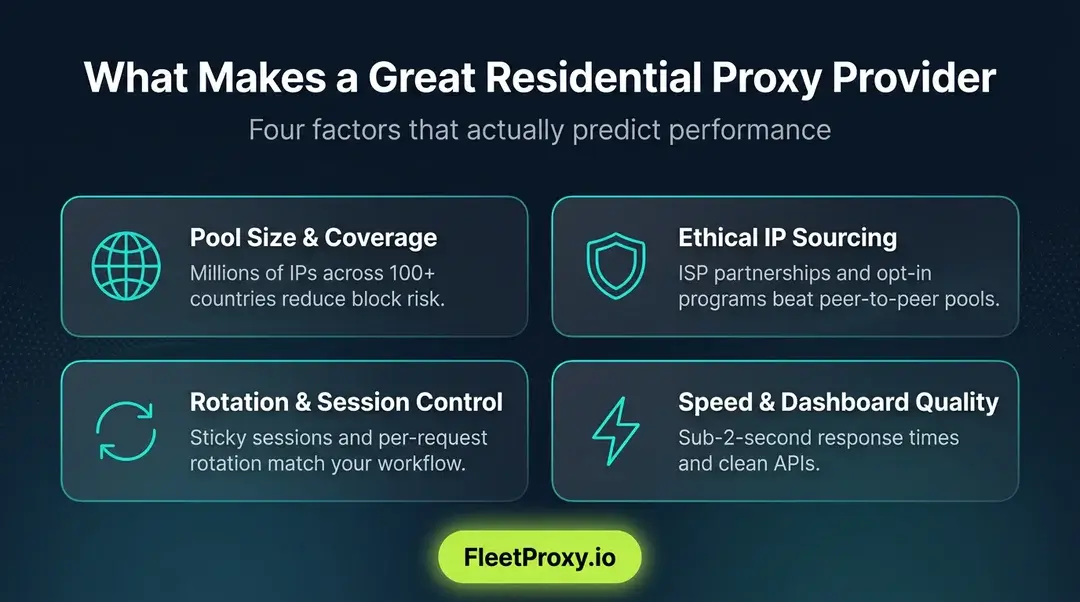
A great residential proxy provider combines ethically sourced IP pools, reliable rotation, transparent pricing, and strong session control. Pool size alone doesn't predict performance. What matters is how the IPs were collected, whether rotation works under load, and how cleanly the service integrates into your existing workflow.
Pool Size and Geographic Coverage
The strongest services maintain millions of real IP addresses across 100+ countries. Larger pools reduce block risk and open up precise geo-targeting. Pool size matters up to a point, though. Proxy server fundamentals explain why source legitimacy matters more than raw IP count for connection trust.
IP Quality and Ethical Sourcing
Premium services source IPs through legitimate ISP partnerships or transparent opt-in programs. Clean household IPs carry lower block rates than peer-to-peer networks built through questionable methods. Any residential proxy service worth your budget should be upfront about how they build their IP pool.
Rotation and Session Control
Good rotation isn't only about changing IPs often. It's about control. The best residential proxy providers 2026 have to offer let you choose between sticky sessions (holding the same IP for a set period) and automatic rotation, so you can match the behavior to your use case.
Speed, Reliability, and Dashboard Quality
Sub-2-second response times and 99%+ uptime are the baseline for professional-grade service. A clean dashboard and solid API save time every day. Based on FleetProxy's internal metrics, average response times on the rotating residential network stay under 1.2 seconds across 195 countries as of Q1 2026.
Top 10 Best Residential Proxy Providers 2026: Quick Rankings
| Rank | Provider | Starting Price | Pool Size | Free Trial | Best For |
|---|---|---|---|---|---|
| 1 | FleetProxy | $2.65/GB | 195+ countries | 50 MB via chat | Pay-as-you-go leader |
| 2 | Bright Data | $4.00/GB+ | 150M+ | 7-day business | Enterprise data collection |
| 3 | Oxylabs | $6.00/GB | 175M+ | 7-day business | High-volume scraping |
| 4 | Decodo | $4.00/GB | 125M+ | 7 days + refund | Balanced mid-market |
| 5 | NetNut | $3.45/GB | 85M+ | 7-day business | ISP-sourced IPs |
| 6 | SOAX | $3.60/GB | 155M claimed | $1.99 trial | City-level geo-targeting |
| 7 | NodeMaven | $3.50/GB | Undisclosed | No public trial | ISP-verified account work |
| 8 | Webshare | $1.40/GB | 30M+ | Free tier (1 GB) | Prototyping and free testing |
| 9 | Rayobyte | $4.00/GB | 40M+ | 2 GB trial | Ethical sourcing priority |
| 10 | IPRoyal | $1.75/GB | 34M+ | No trial | Budget pay-as-you-go |
1. FleetProxy: Best Pay-As-You-Go Residential Proxy Provider in 2026
Starting Price: $2.65/GB
Pool Coverage: 195+ countries with ethically sourced IPs
Best For: Developers, scrapers, and growing teams that want zero commitment
FleetProxy, known for transparent pay-as-you-go pricing with non-expiring bandwidth, is the strongest choice for teams that want instant activation and no monthly minimum. Rotating residential proxies start at $2.65/GB, volume pricing drops to $1.59/GB at 500 GB, and bandwidth never expires. Sign up, grab credentials, configure rotation, and start sending requests within minutes. No sales call, no enterprise contract, no long-term commitment.
Strengths
- Pay-as-you-go from $2.65/GB with non-expiring bandwidth across 195+ countries
- Automatic IP rotation plus sticky session support for account management workflows
- Clean dashboard with real-time bandwidth analytics and per-request rotation controls
- Instant activation, no sales process, no enterprise contract
- 50 MB trial available via live chat on rotating products, letting you test performance before committing
- Broader product suite including static ISP proxies, mobile LTE, and rotating mobile proxies
Weaknesses
- Smaller advertised IP pool than enterprise-tier competitors
- ASN and carrier-level filtering is not offered at launch
Where the platform stands out is the middle ground. FleetProxy, built for developers and small teams, covers reliable residential proxies for web scraping, ad verification, and SEO monitoring without paying for enterprise features most teams never touch. The service holds a 4.1/5 rating on Trustpilot from 29 reviews.
2. Bright Data: Best for Enterprise Data Collection
Starting Price: $4.00/GB (custom enterprise pricing above that)
Pool Size: 150M+ residential IPs
Best For: Fortune 500 data operations with dedicated infrastructure teams
Bright Data runs the largest residential IP network in the industry with 150M+ real consumer IPs spread across 195 countries. Their platform supports granular geo-targeting down to ZIP code, ASN, and carrier level. The Browser API and Web Unlocker handle hard targets that standard proxies struggle with.
Strengths
- 150M+ IPs with city, ZIP, ASN, and carrier targeting as standard
- Enterprise-grade compliance documentation (GDPR, CCPA, ISO 27001)
- Web Unlocker and Scraping Browser for difficult targets
- 99.9% uptime SLA with dedicated account managers
Weaknesses
- Steep pricing starts at $4/GB and climbs with features
- Sales-driven onboarding creates friction for smaller teams
- KYC process required for most accounts
For Fortune 500 data collection with precise geo requirements, Bright Data remains the benchmark. The cost makes it impractical for anyone outside enterprise budgets though. Their official residential proxy documentation covers the full feature set in detail.
3. Oxylabs: Best for High-Volume Scraping Operations
Starting Price: $6.00/GB (5 GB starter plan)
Pool Size: 175M+ residential IPs
Best For: Established businesses running petabyte-scale scraping
Oxylabs operates the largest advertised residential pool in 2026 with 175M+ ethically sourced IPs. As Proxyway's 2026 market research puts it, Oxylabs delivers
"class-leading performance, stable and highly scalable."
Their targeting covers country, city, ASN, and ZIP code.
Strengths
- Largest verified pool at 175M+ IPs across 195 countries
- Country, city, ASN, and ZIP code targeting as standard
- Dedicated account management and scraping APIs
- Strong success rates on aggressive anti-bot targets
Weaknesses
- Expensive across all tiers, starting at $6/GB
- Session control capped at 30 minutes
- Not beginner-friendly for smaller workloads
4. Decodo (formerly Smartproxy): Balanced Mid-Market Choice
Starting Price: $4.00/GB
Pool Size: 125M+ residential IPs
Best For: Freelancers, small agencies, and startups
Decodo rebranded from Smartproxy in late 2025 and kept the user-friendly reputation intact. Clean interface, straightforward setup, and solid documentation. The residential proxy network performs well for most standard applications, and pricing stays reasonable for small teams. Based on AIMultiple's 100,000-request benchmark, Decodo consistently delivers strong GB-per-dollar value as monthly bandwidth scales above 100 GB.
Strengths
- 125M+ IP pool across 195 countries
- Combined sticky and rotating sessions in one plan
- 7-day free trial and 14-day money-back guarantee
- ISO/IEC 27001:2022 certified infrastructure
Weaknesses
- Limited advanced targeting compared to Oxylabs or Bright Data
- Occasional IP quality inconsistencies in niche regions
5. NetNut: Best for Direct ISP-Sourced Residential IPs
Starting Price: $3.45/GB (28 GB minimum plan)
Pool Size: 85M+ residential IPs
Best For: Workflows where IP cleanliness is non-negotiable
NetNut's differentiator is direct ISP partnerships instead of peer-to-peer sourcing. This typically translates to higher-quality IPs and better success rates on challenging anti-bot targets. Their network performs well where IP quality is the priority.
Strengths
- Direct ISP relationships for cleaner residential IPs
- High success rates on sites running advanced bot detection
- Detailed usage stats including response time and error rate
Weaknesses
- 28 GB minimum plan blocks small-scale testing
- No ASN pairing with country filters
- More errors than top-tier providers despite clean IPs
6. SOAX: Best for City-Level Geo-Targeting
Starting Price: $3.60/GB
Pool Size: 155M claimed (actual pool is smaller per independent testing)
Best For: Market research, ad verification, teams needing city-level targeting
SOAX maintains clean proxy pools with strong geo-targeting including city-level US selection. The service suits teams running SEO tracking, competitor monitoring, or ad verification where location accuracy is critical. Proxyway's 2026 testing notes the real usable pool size is smaller than the advertised 155 million.
Strengths
- City, state, and ASN targeting across all plans
- Pay-as-you-go pricing options
- Clean IP pools with low blacklisting risk
- UDP protocol support on all plans
Weaknesses
- No fully free trial (paid $1.99 trial only)
- Speed inconsistencies reported under high load
- Pricing climbs quickly with bandwidth requirements
7. NodeMaven: Best for Social Media and Multi-Account Work
Starting Price: $3.50/GB
Pool Size: Undisclosed (ISP-verified)
Best For: Agencies managing multiple social media accounts or e-commerce storefronts
NodeMaven focuses on ISP-verified residential proxies sourced directly from ISPs, resulting in exceptionally clean IPs with low detection rates. Independent testing reports NodeMaven IPs triggered zero CAPTCHAs during extensive social media testing. Sticky sessions maintain the same IP for up to an hour, which works well for account logins and multi-accounting workflows.
Strengths
- ISP-verified IPs with extremely low detection rates
- Strong sticky session support for account management
- Mid-tier pricing that lines up with workflow value
Weaknesses
- Smaller pool than giants like Oxylabs (exact numbers undisclosed)
- More frequent IP reuse in niche regions
- Pricing less transparent than self-service competitors
8. Webshare: Best Free Tier for Testing Residential Proxies
Starting Price: $1.40/GB
Pool Size: 30M+ residential IPs
Best For: Prototyping, developers testing rotation logic, small budgets
Webshare runs the only genuinely functional free tier in the residential proxy market. The free plan gives you 10 proxies and 1 GB of bandwidth per month with access to most paid features. That makes it the natural landing zone for anyone testing rotation logic before committing. Paid residential plans start at $1.40/GB, among the cheapest in the category.
Strengths
- Free tier with 10 proxies and 1 GB per month
- Lowest entry price at $1.40/GB for paid plans
- Clean self-service dashboard, no sales call required
- Browser extensions and straightforward API
Weaknesses
- Residential IP quality below tier-one providers on hard anti-bot targets
- Smaller pool than most competitors at 30M+
- Customer support is email-only
9. Rayobyte: Best for Ethical Sourcing Priority
Starting Price: $4.00/GB
Pool Size: 40M+ residential IPs
Best For: Teams where sourcing transparency and compliance matter most
Rayobyte runs a US-based operation with strong ethics-first positioning. All residential IPs are sourced with full user consent, strict abuse prevention, and sustainability initiatives. The company leans into trust and compliance as a core differentiator, making it well-suited for enterprise data collection where sourcing transparency matters.
Strengths
- Transparent ethics-first sourcing model
- 40M+ residential IPs across 163+ locations
- US-based infrastructure with consultative support
- Good fit for e-commerce data collection, SERP tracking, and AI training datasets
Weaknesses
- Pricing on par with premium tiers despite smaller pool
- Less granular geo-targeting than enterprise leaders
10. IPRoyal: Budget Pay-As-You-Go Option
Starting Price: $1.75/GB
Pool Size: 34M+ residential IPs
Best For: Hobbyists, researchers, and irregular workloads
IPRoyal keeps things simple and cheap. The pay-as-you-go model means non-expiring traffic, which works well for freelancers or small SEO projects that don't run constantly. Performance is adequate for basic tasks and the lack of commitments makes it low-risk to test.
Strengths
- Low entry price at $1.75/GB
- Non-expiring traffic on all plans
- HTTP/HTTPS and SOCKS5 support
- No minimum commitments
Weaknesses
- Smaller pool than enterprise providers at 34M+
- Limited advanced features and geo-granularity
- Speed varies by region
Other Providers Worth Knowing in 2026
Several other residential proxy providers appear regularly in independent rankings and deserve a mention. DataImpulse offers pay-as-you-go residential plans from around $1/GB with 195+ country coverage, though IP quality varies at the lowest tier. ProxyEmpire runs a 30M+ IP pool with bandwidth rollover and unlimited concurrent sessions, popular among social media managers.
However, Infatica is a mid-market provider whose infrastructure Proxyway testing found faster than some enterprise giants. Live Proxies built a reputation in the sneaker community before expanding into general-purpose residential supply. MarsProxies targets individual users and small businesses with residential IPs from around $4.99/GB.
Which Residential Proxy Provider Is Cheapest in 2026?
It depends on volume. Webshare wins on entry pricing at $1.40/GB for small workloads, followed by IPRoyal at $1.75/GB. The platform delivers better cost-per-value at scale, dropping from $2.65/GB entry to $1.59/GB at 500 GB with non-expiring bandwidth.
At 100 GB per month, FleetProxy, offering instant activation with no sales call, costs approximately $212, compared to Bright Data at around $400, Oxylabs at around $550, and Decodo at around $300. Enterprise options remain the most expensive, justified only by their advanced feature depth.
Rotating vs Static Residential Proxies: Which Do You Need?
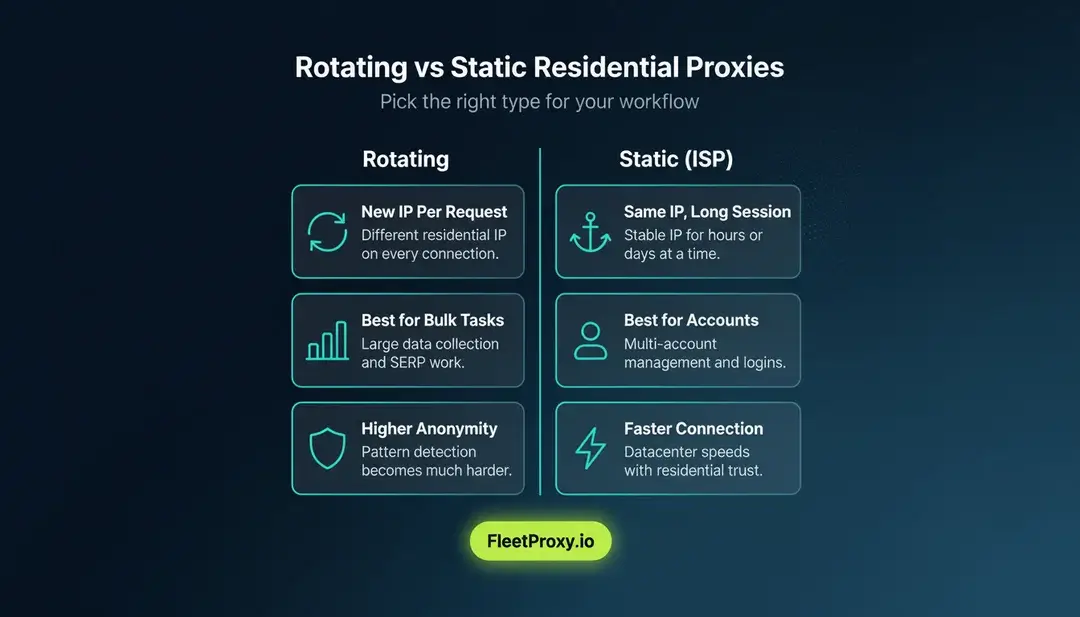
It depends on your workflow. Rotating residential proxies assign a new IP on every request or time interval, making them the right choice for large-scale web scraping and avoiding rate limits. Static residential proxies hold the same IP for long sessions, making them better for account management, marketplace monitoring, and workflows needing session continuity.
-
Rotating residential proxy:
- Routes each request through a different real consumer IP. Best for bulk scraping, SERP data collection, and anti-bot evasion.
-
Static residential proxy:
- Keeps the same ISP-assigned IP across a long session. Best for account management, e-commerce automation, and long-session tasks.
How Do You Choose the Right Residential Proxy Service?
It depends on your use case, budget, and technical integration complexity. Match the provider to the workflow, not the headline pool size.
Match Provider to Use Case
- Large-scale data collection: Bright Data or Oxylabs for enterprise infrastructure and compliance tooling
- Balanced performance and affordability: The platform or Decodo for rotating residential proxies at mid-market pricing
- Budget operations: Webshare or IPRoyal for pay-as-you-go flexibility on small workloads
- Premium IP quality: NetNut or NodeMaven for direct ISP sourcing and account management
- Free testing first: Webshare's 1 GB free tier for rotation logic prototyping
Verify Geographic Coverage
If city-level targeting is critical, verify actual coverage in your target regions, not just the headline country count. Performance varies significantly by location across every provider. Run a small test batch before committing to any long-term plan.
Test Technical Integration
The platform, covering 195+ countries with ethically sourced IPs, and Decodo are easier to integrate day-to-day. Bright Data and Oxylabs offer more advanced capabilities but require more setup time and technical depth. Consider your team's experience level before picking a service.
Common Pitfalls to Avoid
Choosing a residential proxy service based on pool size alone is the biggest mistake. A 175M IP pool sounds impressive, but quality beats quantity. A smaller pool of ethically sourced, well-maintained household IPs often outperforms a massive peer-to-peer pool with questionable origins.
Skipping geographic testing is another trap. Providers perform differently across regions. Test in your actual target areas before signing a contract. Underestimating rotation needs causes silent failures. Basic rotation isn't enough for many use cases, so confirm the provider's session control options match what your operations require.
Overlooking provider restrictions bites hard later. Premium providers like Bright Data, Oxylabs, and NetNut block access to specific categories of sites on their residential networks, including streaming services, financial institutions, ticketing platforms, and some government domains. Verify your target sites are allowed before committing to a paid plan.
FAQs
Q1: What are the best residential proxy providers in 2026?
Ans: The top residential proxy providers in 2026 are FleetProxy, Bright Data, Oxylabs, Decodo, NetNut, SOAX, NodeMaven, Webshare, Rayobyte, and IPRoyal. The first leads on pay-as-you-go flexibility at $2.65/GB with non-expiring bandwidth. Bright Data leads on enterprise depth with 150M+ IPs and ZIP code targeting. Oxylabs leads on scale with 175M+ ethically sourced IPs. Each targets a different buyer segment across enterprise, mid-market, and budget tiers.
Q2: Which residential proxy service is cheapest per GB?
Ans: Webshare has the lowest entry price at $1.40/GB for paid residential plans and the only genuine free tier in the market with 10 proxies and 1 GB per month. IPRoyal follows at $1.75/GB. Pay-as-you-go plans from mid-market providers become cheaper at volume, with rates dropping to around $1.59/GB at 500 GB when bandwidth doesn't expire. Enterprise options like Bright Data and Oxylabs start at $4-6/GB and justify the premium only with advanced targeting and compliance features.
Q3: Which residential proxy providers offer ZIP code targeting?
Ans: Bright Data and Oxylabs both offer ZIP code-level geo-targeting on US residential proxies, and Bright Data extends this to ASN and carrier-level precision. Decodo offers ZIP code targeting in the US only. The platform offers country-level granularity across 195+ countries, which fits most scraping and SEO monitoring workflows. For hyper-local ad verification or address-specific research, Bright Data and Oxylabs are the standard choices.
Q4: Is there a free residential proxy provider in 2026?
Ans: Webshare offers the only genuine free residential proxy tier in 2026, with 10 proxies and 1 GB of bandwidth per month at no cost, plus access to most paid features. This makes it the best starting point for testing rotation logic before committing to paid infrastructure. FleetProxy, offering instant activation with no sales call, provides a 50 MB trial on rotating products via live chat on request. Decodo, Oxylabs, and NetNut offer paid or time-limited trials rather than ongoing free access.
Q5: What sites do residential proxy providers block?
Ans: Most premium residential proxy providers block or restrict access to specific categories of sites on their networks. Oxylabs publicly blocks Apple domains, including iTunes and App Store, PlayStation and entertainment platforms, banking and financial institutions, some Google domains, government websites, streaming platforms, and ticketing services. Bright Data and NetNut maintain similar restrictions. Budget providers tend to have fewer formal restrictions but may enforce usage policies on a case-by-case. Always verify target sites are allowed before committing to a paid plan.
Q6: Do residential proxies work with Puppeteer and Selenium?
Ans: Yes, residential proxies work with all major scraping frameworks, including Puppeteer, Selenium, Playwright, Scrapy, and BeautifulSoup. Most providers give you a standard HTTP/HTTPS or SOCKS5 endpoint you plug into your automation script. The platform, supporting residential, mobile, datacenter, and ISP proxy types, provides ready-to-use code examples for Python, JavaScript, Go, and cURL in the documentation.

Michael Maelar
Head of Proxy Infrastructure


Michael Maelar leads proxy infrastructure at FleetProxy, where he focuses on residential and mobile IP network performance, ethical sourcing, and rotation engineering. Before joining FleetProxy in 2025, he spent six years working on web scraping infrastructure and anti-bot evasion for e-commerce data teams. He writes about proxy networks, scraping reliability, and the practical tradeoffs between provider tiers.


Ready to try FleetProxy?
Residential proxies from $2.65/GB on real IPs across 100+ countries. Instant activation with 24/7 expert support.
Get StartedMore popular posts
Tips to Use a JP Web Proxy to Browse Japanese Websites Safely.
Have you ever clicked on a link to an exciting Japanese video, a regional news article, or a unique e-commerce site, only to be met with a frustrating error message? "This content is not available in your region." This digital barrier, known as geo-blocking, is a common hurdle for international fans of Japanese culture, researchers, and expats alike.

How to Use SOCKS5 Proxy on iPhone
SOCKS5 proxy is a safe connection protocol that directs your internet traffic over another server. This server covers your actual IP address and provides a new one.
How much does an IP address cost in 2025?
The IP address cost in 2025 varies across regions. Larger blocks are cheaper per IP but costly overall, while smaller blocks offer more stability, clarity and security. No matter the option, understanding these trends helps businesses make smarter and more cost-effective decisions