FleetProxy vs Oxylabs: The Honest Comparison for Developers and Small Teams
Insights22/04/2026, 15:38Modified 14/09/2026, 01:105 min read
Looking for an Oxylabs alternative that actually fits your budget? You're in the right place. Oxylabs is a solid choice for enterprise-scale scraping if you have the procurement team to match. But for developers, small agencies, and growing teams, the $6/GB entry pricing and mandatory sales calls tend to cause more pain than value.
Recommended: FleetProxy rotating residential network.
FleetProxy takes a different approach. Pay-as-you-go from $2.65/GB. No contracts. No sales calls. Non-expiring bandwidth. So which one should you actually pick? It is really about what you are building and how much you plan to use.
Let's break it down.
Quick Comparison: FleetProxy vs Oxylabs at a Glance
FleetProxy and Oxylabs compared on pricing, pool size, trial access, and target buyer in 2026
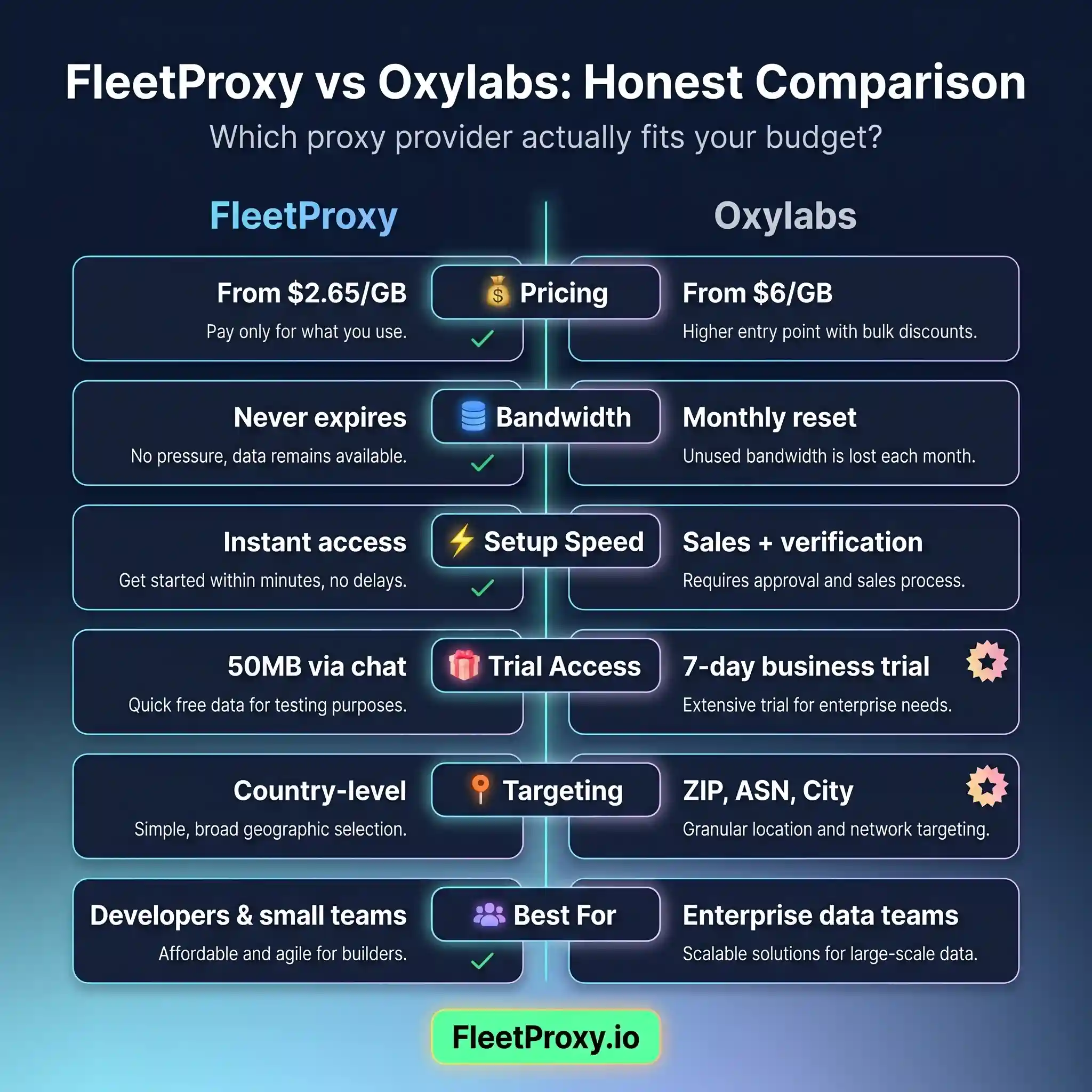
| Feature | FleetProxy | Oxylabs |
|---|---|---|
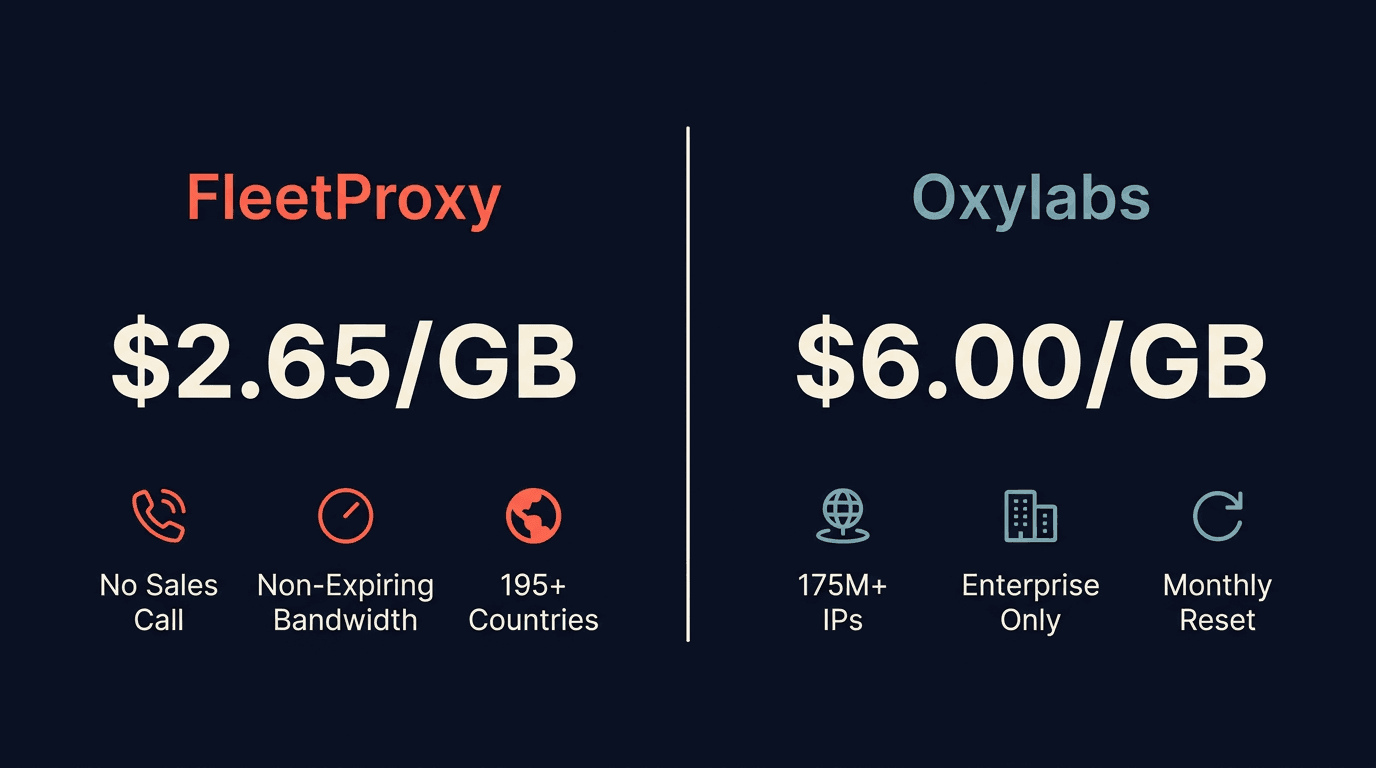
| Starting price | $2.65/GB | $6.00/GB (5 GB plan) |
| Volume pricing | $1.59/GB at 500 GB | $4-5/GB enterprise tier |
| IP pool | 195+ countries | 175M+ IPs, 195 countries |
| Bandwidth | Never expires | Monthly reset |
| Trial access | 50 MB via chat | 7-day business only |
| Sales call required | No | Yes, for most accounts |
| ZIP/ASN targeting | Country-level only | ZIP, ASN, city |
| Best for | Developers, small teams | Enterprise data teams |
Pricing: Where FleetProxy Pulls Ahead as an Oxylabs Alternative
Let's start with the thing everyone actually cares about: "Money"
Oxylabs sits at the premium end. Their residential proxy pay-as-you-go rate is $8/GB at full price, though most people hit $6/GB on the 5 GB starter plan. To get to their cheaper volume rates, you need to commit to bigger plans. Most of those require talking to sales first.
FleetProxy does the opposite. You sign up, buy whatever amount you want, and that's it. Starting rate is $2.65/GB. Volume discounts kick in automatically. At 500 GB, you're paying $1.59/GB. Already cheaper than most providers in the market, let alone Oxylabs.
The bigger difference? Bandwidth that does not expire. Most proxy providers reset your allocation every month. Didn't use all 50 GB this month? Too bad. FleetProxy doesn't work that way. Your bandwidth sits there until you use it, however long that takes.
Put it together. If you run 100 GB per month, Oxylabs costs you roughly $550. FleetProxy costs around $212. That's a 60% saving with no meaningful quality loss for most scraping workflows.
Features: Where Oxylabs Still Wins
Now let's be fair. Oxylabs earns its enterprise reputation for a reason.
The IP pool is massive. 175M+ ethically sourced residential IPs across 195 countries. Proxyway's 2026 market research describes it as "class-leading performance, stable and highly scalable."
And the targeting options are genuinely advanced. ZIP code precision. ASN selection. City-level filtering across all plans. If you're doing hyper-local ad verification or geo-specific scraping at scale, this level of control matters.
Oxylabs also throws in enterprise features that most teams will never touch, but some need:
- Dedicated account managers on higher plans
- SOC 2 compliance documentation
- Scraper APIs for specific verticals (e-commerce, SERP, travel)
- AI-powered proxy rotation
None of that is cheap. But if your procurement team requires a named enterprise vendor with formal SLAs, Oxylabs delivers.
Setup and Usability: Fast vs Formal
This is where the difference between the two really shows up.
With FleetProxy, you're running in under 5 minutes. Sign up, get credentials, plug them into your scraper, and hit a live endpoint. Done. No KYC, no verification wait, no onboarding call.
Oxylabs takes longer. Their process involves:
- Account registration
- KYC verification for most accounts
- Often a sales call before getting a trial
- Contract negotiation on enterprise plans
None of this is a dealbreaker. But if you're a solo developer or small team trying to ship a scraping project this week, the friction adds up fast. And if Oxylabs decides your use case doesn't fit their compliance requirements, you might not even get access.
Worth knowing. Premium providers like Oxylabs block certain categories of sites on their residential networks. Apple, PlayStation, banking platforms, government domains, and streaming services. All restricted. FleetProxy has fewer formal restrictions, making it more flexible for a wider range of projects.
Performance: What the Benchmarks Actually Show
Raw performance is where Oxylabs has historically been strong. Proxyway's 2026 testing puts them at 99%+ success rates on standard anti-bot targets with sub-second response times.
FleetProxy isn't running independent third-party benchmarks yet (it's a newer provider). But internal metrics show average response times under 1.2 seconds across 195 countries as of Q1 2026. Good enough for SEO monitoring, ad verification, e-commerce data collection, and most scraping workflows.
Where does the performance gap actually matter? When you're running petabyte-scale operations against the hardest anti-bot targets. That's where Oxylabs justifies its premium. For everything else, the difference is barely noticeable.
Which One Should You Actually Pick?
Pick Oxylabs if:
- You're running enterprise-scale scraping (millions of requests daily)
- Your compliance team requires SOC 2 and named vendor contracts
- You need a ZIP code or ASN-level targeting
- Budget is not the deciding factor
Pick FleetProxy if:
- You want to start in minutes without a sales call
- Your monthly bandwidth is under 500 GB
- You value non-expiring bandwidth (irregular or seasonal workloads)
- You need a real Oxylabs alternative that cuts your proxy bill by 50-60%
- You're building out your infrastructure and don't want a 6-month enterprise onboarding
Both providers work. They're just built for different buyers.
Conclusion!
If you're reading this, you're probably looking for an Oxylabs alternative that doesn't come with a $500/month minimum or a mandatory sales process. The platform covers that gap. Rotating residential proxies from $2.65/GB, bandwidth that doesn't expire, and access in under 5 minutes. Grab a test run at the pricing page and benchmark it against your actual targets before committing.
FAQs
Q1: Is there a cheaper alternative to Oxylabs?
Ans: Yep, plenty of them. Oxylabs sits at $6-8/GB. The platform starts at $2.65/GB and drops to $1.59/GB once you buy 500 GB. Plus, the bandwidth doesn't expire. Decodo and IPRoyal work too if you want other options. For most scraping jobs outside enterprise-scale work, the quality gap isn't big enough to justify paying triple.
Q2: Why is Oxylabs so expensive?
Ans: Because they sell to enterprise buyers. That's it. Their $8/GB rate and minimum commitments exist for Fortune 500 data teams running massive operations. If you're a smaller team, you end up paying for stuff you won't touch. Dedicated account managers, SOC 2 docs, AI rotation engines. Nice to have. Not worth the markup for most workloads.
Q3: Does Oxylabs offer a free trial?
Ans: Kind of. They give you 7 days free, but only if you're a business and only after a sales verification process. No self-service free tier. Other providers make it way easier. Pay-as-you-go plans start under $3/GB. Some offer instant 50 MB test batches through live chat. No phone calls, no verification waits.
Q4: What's the best Oxylabs alternative for small teams?
Ans: Honestly? The platform is the easiest pick. Pay-as-you-go from $2.65/GB. No monthly minimum. Bandwidth that doesn't expire. And no sales call before you can send a request. Decodo is another decent option if you want a more established brand, though it costs more at $4/GB. Both beat Oxylabs on price by a wide margin.
Q5: Can I switch from Oxylabs without breaking my scraper?
Ans: Shouldn't be a problem. Swap the host and credentials in your scraper config. Done. Both platforms use the same endpoint types, HTTP, HTTPS, or SOCKS5 with a username and password. Rotation settings live in the dashboard like most providers. No code changes needed beyond the connection string.

Michael Maelar
Head of Proxy Infrastructure


Michael Maelar leads proxy infrastructure at FleetProxy, where he focuses on residential and mobile IP network performance, ethical sourcing, and rotation engineering. Before joining FleetProxy in 2025, he spent six years working on web scraping infrastructure and anti-bot evasion for e-commerce data teams. He writes about proxy networks, scraping reliability, and the practical tradeoffs between provider tiers.


Ready to try FleetProxy?
Residential proxies from $2.65/GB on real IPs across 100+ countries. Instant activation with 24/7 expert support.
Get StartedMore popular posts
Tips to Use a JP Web Proxy to Browse Japanese Websites Safely.
Have you ever clicked on a link to an exciting Japanese video, a regional news article, or a unique e-commerce site, only to be met with a frustrating error message? "This content is not available in your region." This digital barrier, known as geo-blocking, is a common hurdle for international fans of Japanese culture, researchers, and expats alike.

How to Use SOCKS5 Proxy on iPhone
SOCKS5 proxy is a safe connection protocol that directs your internet traffic over another server. This server covers your actual IP address and provides a new one.
How much does an IP address cost in 2025?
The IP address cost in 2025 varies across regions. Larger blocks are cheaper per IP but costly overall, while smaller blocks offer more stability, clarity and security. No matter the option, understanding these trends helps businesses make smarter and more cost-effective decisions