FleetProxy vs Bright Data: Which Proxy Network Is Right for You?
Insights13/04/2026, 12:30Modified 14/09/2026, 02:054 min read
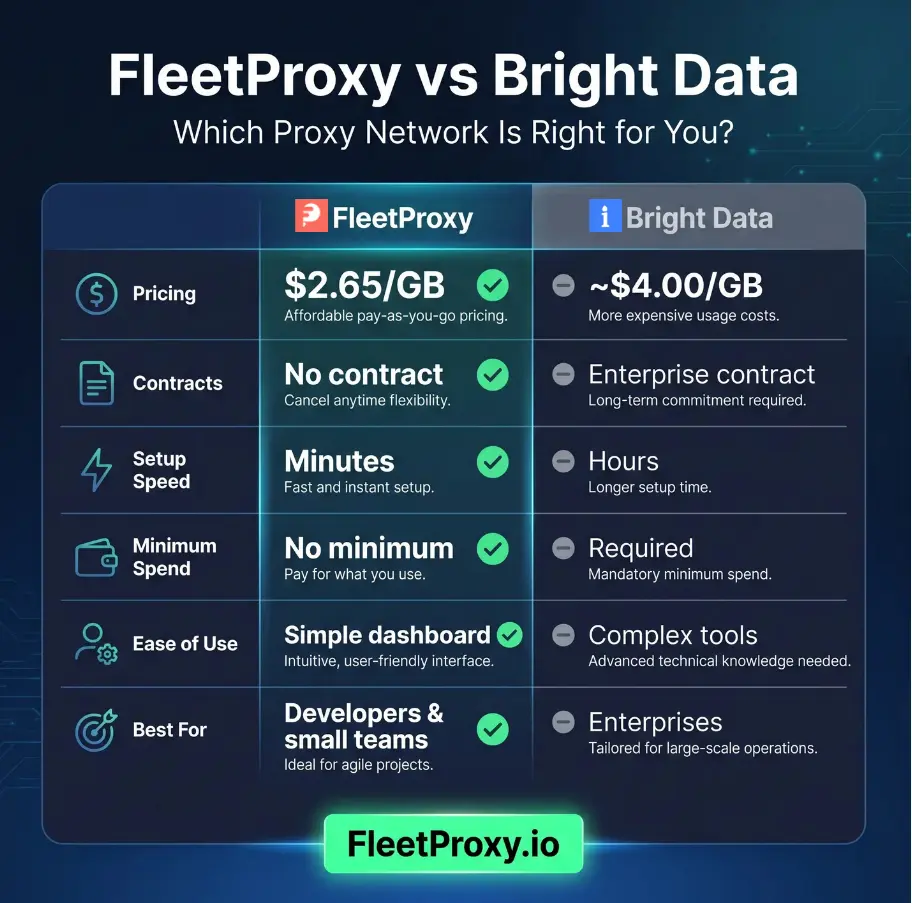
FleetProxy starts at $2.65/GB for rotating residential proxies with no contract and no minimum spend. Bright Data starts at ~$4.00/GB and requires enterprise contracts with sales calls before you get started. If your proxy budget is under $500/month, FleetProxy is the more practical choice. If you're running petabyte-scale operations with a Fortune 500 compliance team, Bright Data earns its premium.
This is the short version. Below is the full breakdown across pricing, pool size, setup, and use cases so you know exactly which one fits your situation.
Quick Comparison: FleetProxy vs Bright Data
| Feature | Bright Data | FleetProxy |
|---|---|---|
| Starting Price | ~$4.00/GB | $2.65/GB |
| Volume Price (500 GB) | Contact sales | $1.59/GB |
| Contract | Enterprise contracts | None, never expires |
| Minimum Spend | Yes | No minimum |
| Setup Time | Hours | Minutes |
| Residential IP Pool | 72M+ IPs | Ethically sourced, global |
| Rotation | Sticky + rotating | Sticky + rotating |
| Proxy Types | Residential, DC, Mobile, ISP | Residential, DC IPv4/v6, Mobile, ISP, SOCKS5 |
| Geo-Targeting | Country, state, city, zip | Country, state, city |
| Best For | Enterprise | Developers, small teams |
What Bright Data Offers
Bright Data runs one of the largest proxy networks in the industry. Their residential IP pool comprises 72 million+ addresses across 195 countries. The platform includes a proxy manager, geo-targeting at city level, session control, browser extensions, and compliance documentation strict enough for Fortune 500 legal teams.
This depth comes at a cost. Residential proxies start around $4/GB, and the pricing structure requires you to talk to a sales team before committing to anything meaningful. The onboarding process takes time. The dashboard assumes a dedicated ops person is managing proxy infrastructure full-time. For large enterprises with procurement departments and five-figure monthly proxy budgets, this works.
For a developer or a small team, most of these features add friction instead of value.
What FleetProxy Offers? (Best Alternative to Bright Data)
FleetProxy gives you access to ethically sourced rotating residential proxies with automatic IP rotation. Your requests route through real consumer IP addresses, so anti-bot systems treat your traffic as normal browsing activity instead of flagging datacenter signatures.
Residential proxy pricing starts at $2.65/GB with no monthly commitment. There's no sales call. No enterprise contract. No minimum spend. You sign up, grab your credentials, configure rotation through the dashboard, and start sending requests within minutes.
The platform also supports static ISP proxies, mobile LTE proxies, datacenter IPv4 and IPv6, and rotating mobile proxies, so you're not locked into a single proxy type as your project grows.
Residential Proxy Pricing: FleetProxy vs Bright Data
Pricing is the sharpest divide in this proxy network comparison. Bright Data's residential proxy rates start at $4/GB and go up depending on features and volume commitments. Their pricing model rewards scale, but the entry point is steep for anyone testing an idea or running a lean operation.
The alternative starts at $2.65/GB. Buy 50 GB and the rate drops to $2.38/GB. At 250 GB, $1.86/GB. At 500 GB, $1.59/GB. Every plan activates instantly, never expires, and requires no monthly commitment. For anyone searching for an affordable residential proxy provider in 2025, this is one of the lowest entry points on the market.
For most proxy network comparison searches, cost per GB is the deciding factor. If your scraping budget is under $500/month, the math here isn't close.
Does IP Pool Size Matter When Choosing a Residential Proxy?
Does pool size matter for residential proxies? Yes, but only to a point. Bright Data's 72 million IPs give them an edge for hyper-specific geo-targeting at a massive scale. If you need residential IPs from a particular zip code across millions of daily requests, their depth is relevant.
For the majority of web scraping, data collection, and automation use cases, what matters is whether the IPs come from real residential networks, whether rotation works reliably, and whether your requests get through without blocks. The platform handles all three. Ethically sourced IPs, automatic rotation, and real residential traffic patterns keep success rates high without requiring you to pay for pool capacity you'll never touch.
Pool size past a certain threshold is a marketing number, not a performance indicator. The best residential proxy for your project is the one with clean IPs, reliable rotation, and a price you don't have to justify before proving your concept.
How Easy Is It to Set Up Each Proxy Service?
Bright Data's dashboard is feature-rich. Proxy manager, API endpoints, dozens of configuration panels. For teams with dedicated proxy infrastructure engineers, this makes sense. For everyone else, it means spending hours on setup before sending a single request.
The dashboard here takes a different approach. Bandwidth tracking, rotation controls, and usage stats in one clean interface. You configure your proxies, point your scraper at the endpoint, and it works. The platform's API integration supports cURL, Python, JavaScript, and Go, with ready-to-use code examples in the documentation.
If you want to test the setup without talking to anyone, you go to the pricing page and start.
When Bright Data Makes Sense?
Pick Bright Data if your situation looks like this:
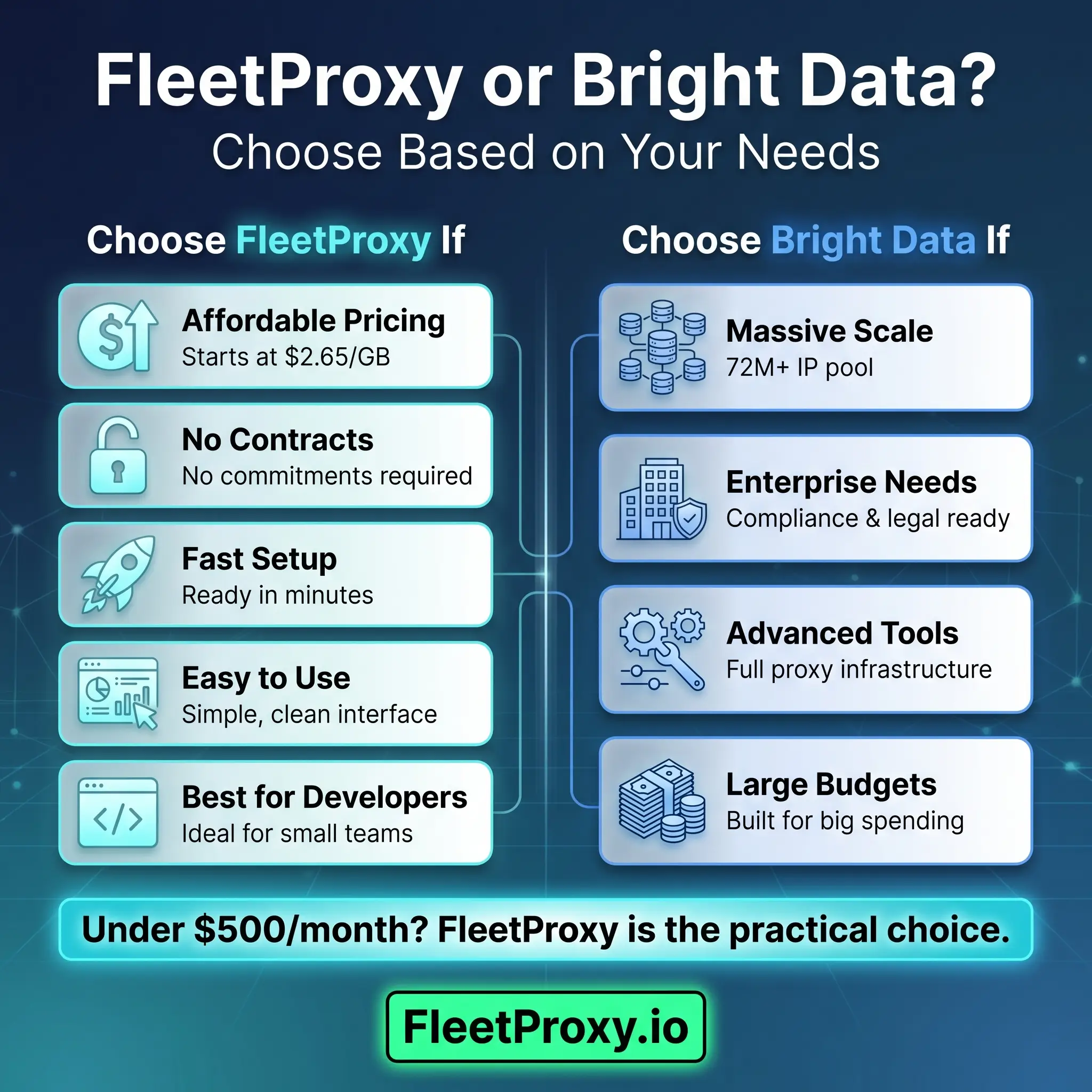
- Petabyte-scale data operations across dozens of countries
- Vendor compliance documentation required by your legal team
- Dedicated account manager on speed dial
- Monthly proxy budget in the five-figure range
Bright Data earns its premium at this level. Don't pick it because it's the biggest name. Pick it because your requirements match what it's built for.
When the Alternative Makes More Sense
Pick the platform if this describes you:
- Building a scraper or running automation workflows
- Reliable residential IPs with working rotation out of the box
- No sales process standing between you and a test run
- Reasonable budget without enterprise-level overhead
FleetProxy is the Bright Data alternative built for developers and growing teams who haven't scaled into enterprise territory yet, and don't want to pay as if they have. If you're looking for a cheap residential proxy with clean IPs and no strings attached, this is where to start.
Frequently Asked Questions (FAQs)
Q1: Is FleetProxy a legitimate Bright Data alternative?
Ans: Yes. The service provides ethically sourced residential IPs with automatic rotation. It covers the core proxy use cases, including web scraping proxies, data collection, ad verification, and SEO monitoring, at a price point suited for smaller teams and solo developers.
Q2: Does the service work for large-scale scraping?
Ans: Yes. The platform handles high-volume requests through rotating residential IPs designed to avoid triggering anti-bot systems. Pricing scales with volume, starting at $2.65/GB and dropping to $1.59/GB at 500 GB.
Q3: How does IP rotation work?
Ans: Rotation is automatic. You control settings through the dashboard, which tracks your bandwidth usage in real time. Sticky sessions and per-request rotation are both supported.
Q4: Is Bright Data better overall?
Ans: Bright Data has a larger IP pool and more enterprise tooling. The alternative is faster to set up, more affordable, and better suited for developers and growing teams who don't need enterprise-level complexity.
Q5: Do I need a long-term contract?
Ans: No. There are no enterprise contracts or minimum spend commitments. Plans never expire and activate instantly.
Q6: What proxy types are available?
Ans: The platform offers rotating residential, static ISP, mobile LTE, datacenter IPv4, datacenter IPv6, rotating mobile, and rotating datacenter proxies.
Your proxy budget should go toward your project, not toward paying for infrastructure you don't need yet. Rotating residential proxies starting at $2.65/GB, instant activation, and no contracts. The offer speaks for itself.

Michael Maelar
Head of Proxy Infrastructure


Michael Maelar leads proxy infrastructure at FleetProxy, where he focuses on residential and mobile IP network performance, ethical sourcing, and rotation engineering. Before joining FleetProxy in 2025, he spent six years working on web scraping infrastructure and anti-bot evasion for e-commerce data teams. He writes about proxy networks, scraping reliability, and the practical tradeoffs between provider tiers.


Ready to try FleetProxy?
Residential proxies from $2.65/GB on real IPs across 100+ countries. Instant activation with 24/7 expert support.
Get StartedMore popular posts
Tips to Use a JP Web Proxy to Browse Japanese Websites Safely.
Have you ever clicked on a link to an exciting Japanese video, a regional news article, or a unique e-commerce site, only to be met with a frustrating error message? "This content is not available in your region." This digital barrier, known as geo-blocking, is a common hurdle for international fans of Japanese culture, researchers, and expats alike.

How to Use SOCKS5 Proxy on iPhone
SOCKS5 proxy is a safe connection protocol that directs your internet traffic over another server. This server covers your actual IP address and provides a new one.
How much does an IP address cost in 2025?
The IP address cost in 2025 varies across regions. Larger blocks are cheaper per IP but costly overall, while smaller blocks offer more stability, clarity and security. No matter the option, understanding these trends helps businesses make smarter and more cost-effective decisions